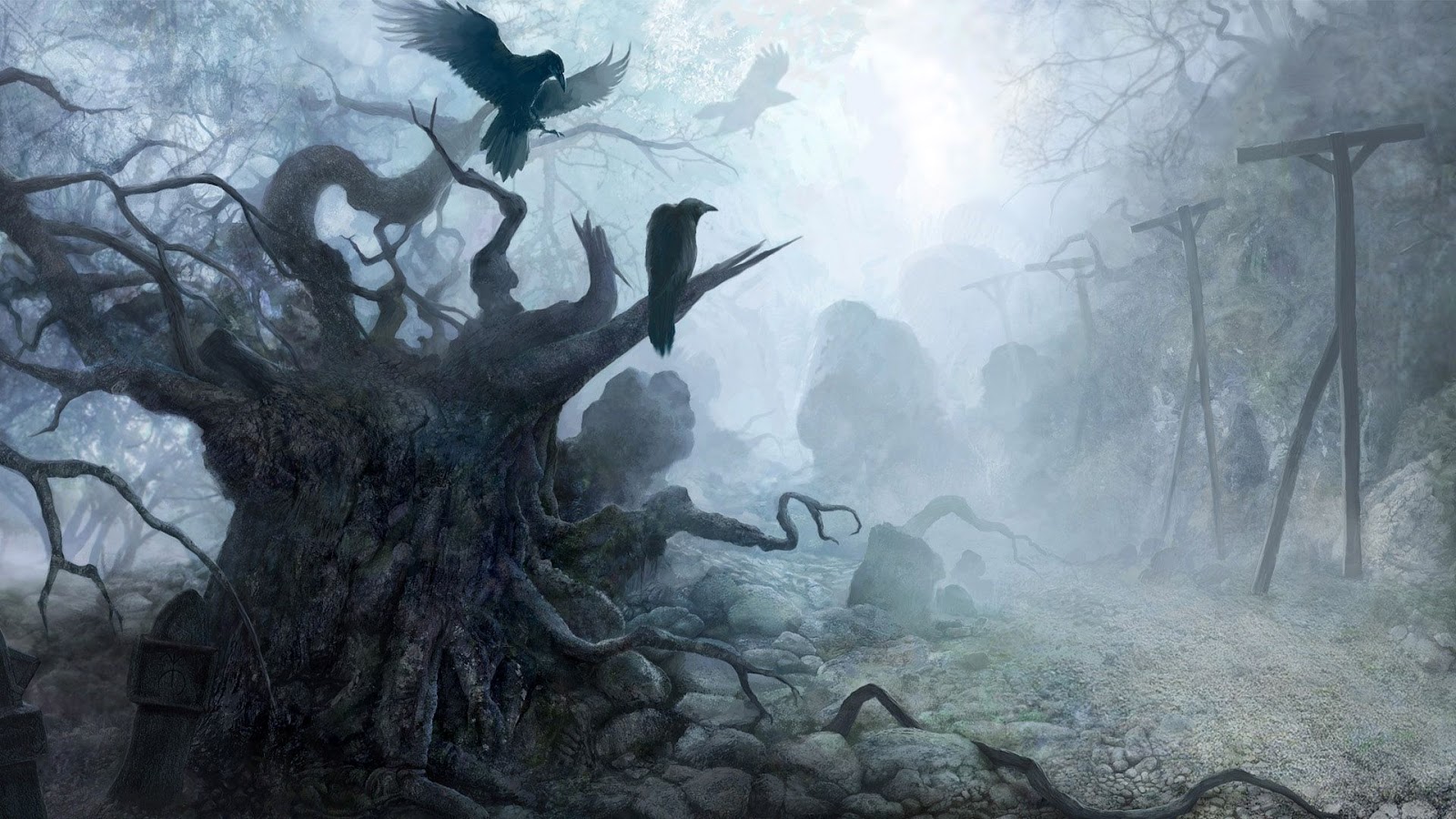
I talk about my Curse of Strahd game a lot on this blog, and I hint at a lot of the changes and additions that I've made to the lore. But I haven't had a place to really delve into those changes. Until now. Welcome to the official Homebrew Lore of Strahd column, where I dive into the personal tweaks I've added to the game. Today I'm going to jump into the actual Mists of Ravenloft, the strange fog that plays such a big part in the adventure.
If you have a character named Badger, Cyrus, Sparrow, Vaclav, Ariane, Flint, or Sascha I suggest you stop reading here. Otherwise continue forward at your own risk...
The Mists of Ravenloft are as capricious as they are ominous; and although Strahd has some control over them, they are not his creation. Indeed, the vampire lord loathes the mists with all his dead heart. For the Mists serve as his eternal prison, trapping him as much as anyone he brings to toy with in his realm.
But what are the Mists of Ravenloft? Why does Strahd have any control over them at all? Well... to understand that, you must understand the reason that Ravenloft exists at all.
You see, Ravenloft is not just the country that Strahd rules. The Mists are more Ravenloft than anything else. The Mists were created or formed for one reason only, to keep the most terrible monsters imprisoned, and to punish them for eternity. Was Strahd a vampire before coming to the mists? Maybe. Probably. Although no one knows for sure. What is sure, is that the vampire lord exists in a state of pure rage, forced to live out his most terrible nightmares over and over again.
Some scholars even believe that Strahd has no control over the mists at all, and they merely react to his whims to enhance his own punishment.
Barovia is the most well known country in the mists. But there are many others, each it's own island surrounded by the terrible fog. Each island is different, but each is ruled over by its own Dark Lord, each lord being punished for their terrible deeds on the material planes. Rumors claim that Lord Soth from Krynn exists somewhere in the obscured lands. Others claim that Vecna himself rules a land of his own from a cursed tower of melting bones. Only one thing is known for certain: there are many islands and many terrors hidden in the Mists of Ravenloft. One must travel with care... if they can travel the mists at all.
Showing posts with label Homebrew of Strahd. Show all posts
Thursday, April 26, 2018
Thursday, April 5, 2018
Homebrew Lore of Strahd: Death Rituals
I talk about my Curse of Strahd game a lot on this blog, and I hint at a lot of the changes and additions that I've made to the lore. But I haven't had a place to really delve into those changes. Until now. Welcome to the official Homebrew Lore of Strahd column, where I dive into the personal tweaks I've added to the game. Today we are starting off with death rituals in Ravenloft.
Death in Ravenloft is the only escape from Strahd's realm. But even then, escape is not easy. Through the Crucible of Souls, Strahd has the ability to trap any soul leaving Ravenloft, condemning it to an eternity of torture.
He has made the eternity of torture public knowledge, although he keeps information about the Crucible to himself. Still, Strahd loves his games, and he has set up a way for souls to escape: when a person dies, they must be buried by an approved priest before the third midnight after their passing. If it is done, he allows the soul to travel on to the afterlife. But if not, the soul is his to do with as he will.
The priests approved by Strahd must complete the entire ritual of death by themselves. They are responsible for preparing the bodies, digging the graves, administering the last prayer. They are allowed no help, and if aid is given Strahd's contract is null and void.
In a land where almost no divine magic persists, Strahd has still created a place for the priesthood. And although he makes sure that the priests are almost always behind in their work, the priests are given great honor and respect. For it is only through them that escape from the horrors of Ravenloft is possible.
Death in Ravenloft is the only escape from Strahd's realm. But even then, escape is not easy. Through the Crucible of Souls, Strahd has the ability to trap any soul leaving Ravenloft, condemning it to an eternity of torture.
He has made the eternity of torture public knowledge, although he keeps information about the Crucible to himself. Still, Strahd loves his games, and he has set up a way for souls to escape: when a person dies, they must be buried by an approved priest before the third midnight after their passing. If it is done, he allows the soul to travel on to the afterlife. But if not, the soul is his to do with as he will.
The priests approved by Strahd must complete the entire ritual of death by themselves. They are responsible for preparing the bodies, digging the graves, administering the last prayer. They are allowed no help, and if aid is given Strahd's contract is null and void.
In a land where almost no divine magic persists, Strahd has still created a place for the priesthood. And although he makes sure that the priests are almost always behind in their work, the priests are given great honor and respect. For it is only through them that escape from the horrors of Ravenloft is possible.
Wednesday, April 4, 2018
Homebrew Lore of Strahd: Divine Magic
I talk about my Curse of Strahd game a lot on this blog, and I hint at a lot of the changes and additions that I've made to the lore. But I haven't had a place to really delve into those changes. Until now. Welcome to the official Homebrew Lore of Strahd column, where I dive into the personal tweaks I've added to the game. Today we are starting off with divine magic in Ravenloft.
Divine magic is powerful in the hands of the righteous and the faithful. It thrives on hope, even in the darkest places. After all, without light there can be no darkness. Without hope there can be no despair. Except in Ravenloft. For there are some places dark enough to extinguish even the last ember of hope in a darkened heart.
Besides, darkness is the natural state of the universe. Those who say that without light there can be no darkness have it backwards. Without darkness there can be no light.
The Crucible of Souls
Deep in the bowels of Castle Ravenloft there is a room containing the Crucible of Souls. The Crucible is a power artifact. Powered by the agony of a thousand souls, maintained by a cult of thirty two dark cultists, the Crucible form a block between Ravenloft and the divine. No god has been able to overcome it's power, and the only divine magic in Ravenloft is that which Strahd allows.
When Strahd wants to let a god have power in his land, he can place a divine symbol of that god into the crucible. Until he takes it out again, divine power from that deity can flow into his realm. But cutting it off is as easy as removing the symbol.
Strahd often places the symbols of the deities that his toys play with. After all, it wouldn't do to allow new divine casters in Ravenloft to believe that he could cut off their magic in an instant. He often lets them keep their power until the final confrontation, and then leaves the clerics and paladins helpless before him.
Divine magic is powerful in the hands of the righteous and the faithful. It thrives on hope, even in the darkest places. After all, without light there can be no darkness. Without hope there can be no despair. Except in Ravenloft. For there are some places dark enough to extinguish even the last ember of hope in a darkened heart.
Besides, darkness is the natural state of the universe. Those who say that without light there can be no darkness have it backwards. Without darkness there can be no light.
The Crucible of Souls
Deep in the bowels of Castle Ravenloft there is a room containing the Crucible of Souls. The Crucible is a power artifact. Powered by the agony of a thousand souls, maintained by a cult of thirty two dark cultists, the Crucible form a block between Ravenloft and the divine. No god has been able to overcome it's power, and the only divine magic in Ravenloft is that which Strahd allows.
When Strahd wants to let a god have power in his land, he can place a divine symbol of that god into the crucible. Until he takes it out again, divine power from that deity can flow into his realm. But cutting it off is as easy as removing the symbol.
Strahd often places the symbols of the deities that his toys play with. After all, it wouldn't do to allow new divine casters in Ravenloft to believe that he could cut off their magic in an instant. He often lets them keep their power until the final confrontation, and then leaves the clerics and paladins helpless before him.
Subscribe to:
Posts (Atom)
Cozy Dark
Cozy Dark is a game I am working on for solo roleplaying. It steals a lot from Ironsworn, a bit from Chaosium's generic roleplaying, an...
-
When I first started Dungeon Mastering I wanted to be completely in charge of the setting and the world. It never occurred to me that other ...
-
Cozy Dark is a game I am working on for solo roleplaying. It steals a lot from Ironsworn, a bit from Chaosium's generic roleplaying, an...
