Showing posts with label Dungeon Mastering. Show all posts

Wednesday, August 23, 2023

A Look Back

 My friend Skullboy recently wrote a post about finding a box of old Dungeons and Dragons stuff. He found his first ever character sheet, some really neat Dragonlance stuff he didn't even understand at the time, and more. And it made me really nostalgic because I have moved many times since I first started playing, and the binder that I used to keep absolutely everything in is long gone. There was a period in my life that I had to move like four times in three years, and during that time a lot of my physical things were given away or thrown out. I dove hard into the digital, because at least there it was easier to store.

So I don't have a picture of the first character I ever made (although it was a 3rd edition Elven Enchanter Wizard named Elendel that took me about five hours to build because I did it on my own and had no idea what I was doing), I don't have any of the hand drawn maps I made on graph paper, or the weird characters I made with my high school friend using completely home brewed classes.

But I wanted to go through all my files and find the oldest thing. What I found was two things. The first was a 28 page conversion of Final Fantasy into 4th edition D&D (which was a pain to design for and is only maybe an eighth of the way finished) and a campaign pitch of a world I called Toryll.

I thought about cutting out one of the Final Fantasy classes and dropping it in. But I don't actually think they are very interesting, and it's sort of like beating a dead horse. There are a lot of Final Fantasy conversions out there. But I am going to include the campaign pitch I made for a flat world where the sun was an evil goddess.

I also found a character sheet for someone named Traunt Jeryn who is clearly the inspiration for one of the NPCs in Toryll. Except the character sheet is for some sort of d100 system that I must have been working on. But also... I have no memory of working on it. Weird. Here's that:

Clearly I was really into Lore at the time, and the Silver Sword is one of the guilds I was working on in the campaign pitch below. But the pitch is for a 4th edition game I have clear memories of running. I sorta remember working on a system inspired by The Golden Compass books - but that doesn't look right to me? That one was built around having a spirit companion, and there is no spirit companion in site here. So I have no idea what I was doing. 

Anyways, here is the campaign pitch for Toryll.

Toryll Campaign Pitch


It is said that commoner's near the hub think the world is round. They say that light is holy and darkness is evil. They say that the Halls of Neverending Light are like heaven, a place for a soul to reach for after death.

It is also said that they are cannibals. I know that they are stupid.

I have peered over The Edge of the world into the Great Abyss. I have seen with my own eyes the agony of souls trapped in the Halls of Never Ending Light. I have seen how the light chars their souls to blackened husks. I have even been one of those blackened husks. My screams were raised with those of Radea, the Light Witch, the Shining Crone, Goddess of Sun and Power.

But I was saved. My soul was called back into blessed darkness. And now, now I am the Chosen of Melwyn.

I fight to save the world. I fight the living light.

~Jeryn Traunt

Torryl (the world): Torryl is an odd place. First of all, the world is square. Not cubed, but sqare. The top of the square is inhabitied with all sorts of people. However, possibly the most interesting fact about Torryl is not that it is square, but that it's people adapted not to day light but to darkness. The world is run during the hours when the Halls of Endless Light are far beneath the square, so that it's light might not scorch the eyes of Melwyn's faithful. The most rural parts of the world are near The Edge, the part of the world where the square ends and there is only the darkness of The Great Abyss. The Edge is also a dangerous place for people to live. Outsiders from The Abyss (and some say from Torryl's underside) roam the wilds and wreak havoc on those foolish enough to wander, or worse, live in such a dangerous place. The most civilized place of the world is at Torryl's geographical center. It is there that the guilds are located, endlessly fighting each other for control of the minds and resources of the world.

The Four Guilds:


The Alliance of Essentia: The Alliance of Essentia is made up of much smaller guilds that have all baned together for a common cause. They seek to rule the world by controlling all the uses of Essentia, and through Essentia Soul Tech. Their mandate is to acquire Essentia in any way possible. Their secondary mandate is to disrupt the Guild Actions of the other three guilds as much as possible.

The Silver Swords: The Silver Swords is a vast guild of mercenaries. The guild leaders believe that if they can get enough mercenaries in enough places then eventually all the kindoms, states, and cities of the world would be helpless without them.

The Pact of Melwyn:
Simply put, the church of Melwyn. It believes in controlling the minds of the world, and thus rulling over them. It deals swiftly with those they think defy the Church and its Order.

The Shadow Faction: A guild of covert doings. It's members are mostly assassins and warlocks and others that thrive in the art of deception. It would rule the world with fear. If a person lives always in fear they are likely to make a pact with the Faction for protection.


Siddion (starting villiage):

In North West corner of Torryl, closer to The Edge than any sane person would live, is a small village of outcasts. The streets are full of disparate people, hopeless people, lost people. It is a place were a person goes only when there is no where else. Soul Tech is a rarity hear. The Guilds of Toryll are a mere rumor.

At Siddion's center is a large spire. It is here that the Great Sorcerer Siddion, the town's namesake, retired after he built the Towers of Perdition to protect his place in the world. It is rumored that the Sorcerer has found the secret of eternal youth, and that he emerges from his tower once every two centuries or so to see how his people have progressed. It is also said that during these brief wandering periods he renews the spells on the Towers of Perdition to protect his province.

The village is ruled by democratic vote; however, it is required by Siddion law that the leader of the Village have an arcane power source. He becomes Magistrate and a representative from each race that currently lives in the village borders with a family, or a race in which there is more than ten people, is elected to be on his council. The Magistrate is bound by powerful Geas to take into consideration anything the council has to say. However, if after taking those things into consideration seriously, he disagrees the Magistrate may make the final decision. The Magistrate rules for ten years and then, if there is another magic user in the village, a new election is held. There is no limit to the number of years a ruler may rule if elected more than once.

The current Magistrate is Laurenthala. She is a Drow Princess, in exile from her homelands in the Scorched Plains, and a follower of the Goddess Radea. However, despite her choice of worship she has proven to be both a wise and intelligent ruler. The people of Siddion have reelected her three times. She has been Magistrate for thirty six years.

The villiage has one inn/tavern, Siddion's Reach. The innkeeper is a Dwarven male who claims to be the long lost heir of forgotten city, Calgas. Not many people in the villiage believe him though.

The rest of the villiage is undeveloped. If you feel you want to create an NPC or anything like that to fit yourself into villiage life feel free.


The Towers of Perdition:

Siddion created the Towers of Perdition centuries ago. The Towers are specifically designed to keep outsiders from intruding on the village of Siddion or the surrounding lands. Any outsider trying to pass through them must obtain Siddion's permission to go through the Barrens, the land the Tower's are built on, or be endlessly trapped in illusions. The Towers do not guard against natives of the material plane, and the enchantments on the towers protect normal wanderers from coming into contact with any outsiders who are currently trapped in the towers illusions. When contact is unavoidable the illusions the outsiders are trapped with do not reveal the travelers.


Diety Choices:

Melwyn, Maiden of the Night:

Melwyn is the Good aligned diety in the world. She is the goddess of darkness and of the grey moon.


Radea, the Light Crone

Melwyn's sister. It is said that Radea created the world, but that soon after she went mad. Her light burned across the world, scarring all the inhabitants. If Melwyn hadn't stepped in and imprisoned the Light Goddess in the Halls of Endless Light then Toryll would be in ruins. Even still, despite her agony, Radea does all she can to bring the world down.


Races and Classes:


Any and all. Let me know what races you are going to play and I will come up with the mythology of them. I think I will try to stray from using the Fey and other plains. This does not mean that Eladrin and Genasi are unplayable, it just means I am going to rework their stories. However, I believe mostly in developing on a need to develop basis. If you are looking for options, yell at me, and I will do some more detail.
 

Thoughts From Now

This was a really fun game to run. I remember that instead of gold value was derived from stories. So there was a mostly bartering economy where a simple ring stolen from the finger of a woman who died for her love was more valuable than a ring with a big diamond that was mined from a collection of other big diamonds. It slowed the game down - we were constantly trying to decide what story was more valuable than other stories, and it's not a system I would publish because I think it really depends on a good group. But I had a good group and we never ran into an issue where someone thought their goods should be more valuable than what we came up with.

And this was my first long term campaign in 4th edition. I started with some friends that had played in my 3.5 games and that had to leave because they didn't like the new system. Not liking 4th edition was a very popular stance back in the day, and these friends didn't just not like the system, but they liked not liking the new system. 

Sometimes people you used to enjoy going on road trips become people you would rather not road trip with. 

I wish I had more visual stuff to post because visuals are interesting. But I do almost all of my design in text, so that's where we are. If you are reading this... it's the first post I've made here in like four years! So welcome back?

Wednesday, June 20, 2018

Homebrew: The Masquerade

I’m working on this homebrew world, and the idea of masks has been floating around in my head for awhile. I really love the idea of masks representing different classes, and the idea that a character could change masks simply by taking one off and putting another on.
Art by: https://lovestruck2.deviantart.com/
Then today I fell down a youtube hole and spend three hours watching Kingdom Hearts videos. All I wanted to do was dump every other thing I’m working on, and jump into a Kingdom Hearts system... especially since there don’t appear to be any really great ones out there (if you know of one, point me in its direction!)

But I resisted. I’m already running three different games. I don’t need to pick up a forth. 
But then the idea of the masks came back to me, and a bunch of things fell together for me.
I really like it when settings have a way to control power. Not everyone should be a level 20 wizard like in Faerun.
So this is what I came up with. In my homebrew world there are three ways to access power (aka, class levels).
  • Training
  • Spellbinding
  • Inheriting or calling a mask.
Training is available for all classes but Sorcerer, and maybe Warlock (depending on what I decide to do with patrons). However, without supernatural means, mortals can only access a certain amount of power. A character can train to a total of five class levels.
Spellbinding. In my world, spells are literal people. They are beings of chaos thrust from the elemental planes to land on the material realm. Sorcerers bind spells, and the different types of spells that they bind act as their origins. Binding one spell let's a Sorcerer train through 5 levels. But then it maxes out, and a sorcerer must bind a new spell. The first spell a Sorcerer binds is the only one that grants an origin, and binding a spell is an inherently evil act.
Inheriting a mask (or performing a masquerade) is the path to ultimate power. A mask allows you to train in any class, up to level 20. Once received, a mask is bound with your soul, and you can never have another. The mask grows along with you, so it starts at level one, and can level from there. Masks can also gain visages which grant them unique appearances and abilities (extra spells, feats, etc). Masks are not inherently good or evil, although many specific masks are associated with good or evil since they are generally handed down from master to apprentice.
In the end, masks ended up looking almost nothing like keyblades. But... that's pretty much where I started from. So, go figure!

Friday, June 15, 2018

Creating the Werewolf


Werewolves. They are an iconic part of the gothic horror mythos. They have been both feared and loved. They have been depicted as savage monsters with no claim to humanity, and normal people dealing with a terrible curse.

And yet, despite how iconic they are, there are no official statistics to create a playable character in Dungeons and Dragons. There have been many attempts online to create a homebrew version of them, but I'm not happy with any of them.

I have a player that really wants to play a werewolf character, and I am a big advocate for letting people play what they want. So this is going to be my stab at a homebrew Werewolf race.

May the gods of luck and fortune have pity on my soul for even trying.

But before I even begin jumping into statistics, we should look at the source material we do have. In the Monster Manual, there are some official rules for what happens when you get cursed with Lycanthropy.


The Curse of Lycanthropy

The Curse of Lycanthropy is contracted by being wounded by a lycanthrope. It can also be contracted if one (or both) of your parents are lycanthropes.

The actual statistics of the curse change depending on the type of lycanthropy a person contracts. For our purposes we'll be discussing werewolves, which gain the following:
  • ·         A Strength score of 15 if their score isn't already higher.
  • ·         The ability to use an action to polymorph into a wolf, or wolf-human hybrid.
  • ·         A +1 bonus to AC while in wolf or hybrid form.
  • ·         40 ft movement speed in wolf form
  • ·         Damage Immunity to: Bludgeoning, Piercing, and Slashing damage from nonmagical weapons that aren't silvered.
  • ·         Advantage on Wisdom (Perception) checks that rely on hearing or smell.
  • ·         A 1d8 Bite Attack in wolf or hybrid form.
  • ·         A 2d4 Claw Attack in wolf or hybrid form.


That's a crazy amount of power. It's no wonder that the Monster Manual says that, "The DM is free to decide that a change in alignment places the character under DM control until the curse of lycanthropy is removed. (207)"

But in addition to providing insane amounts of power, the Werewolf (and other lycanthropy) stat blocks from the Monster Manual also miss out on one of the most iconic abilities that werewolves have in almost every piece of fiction I've ever seen. The ability to heal quickly from wounds. The concept of a werewolf that doesn't have regeneration is ridiculous to me.

However, regeneration is another of those powers that are insanely over powered.

What is a werewolf?

Let's take a step back from statistics for a moment. Instead, let's take a second and think about what a werewolf actually is.

I was going to quote something from dictionary.com here. But their description of a werewolf is woefully unhelpful. So instead, let's make a list of things that I think are iconic to the werewolf mythos:
·         The change. Changing into a werewolf isn't an easy prospect. And there are two types of stories told about the change.
  •           A person who doesn't care about the implications of the change, and what it means. They are monsters, willing to go out and spread the curse.
  •            A person who sees the change as a curse, and does everything they can to prevent the wolf from wreaking havoc in the world. These stories often end in tragedy, with people they love getting infected with the curse.

Either way, the change always happens. It's an inevitable monthly change that can't be fought, only endured or embraced.

  • ·         The Moon. The full moon is the cause of the change. Sometimes just a single night, or sometimes each night for a full three day period.
  • ·         Spreading the curse. Werewolves might tear people to shreds and go on bloody rampages. But the true horror of the werewolf story is that anyone can become one. All that's required is to survive a werewolf attack.
  • ·         Weakness to silver. Enough said.
  • ·         Fast Healing. Werewolves almost always heal from wounds with the efficiency of Wolverine unless they are attacked by a silver bullet.


Those are a lot of abilities, and just like the ones from the monster manual, they are going to be both very powerful abilities, and very punishing abilities. Balanced werewolves are not.

So, where does that leave us? In previous editions of Dungeons and Dragons, I would have either created a monster class or slapped on a level adjustment. I actually think that a monster class is still the way to go.

But my player is interested in playing a Werewolf Blood Hunter. So slapping on a monster class doesn't allow my player to play what they want. And as I said, I'm a big advocate for letting people play what they want if it can be made to work.

So that leaves us with the last (and hardest) option. Creating a homebrew werewolf race that both reflects the concept of the creature, but maintains balance with the other race options available.

Let's take a deep breath, cross our fingers, and jump right in.

The Process

The first thing we need to do is make a decision about the change. Is it voluntary? Can a character hold off the change with a Constitution check? Can the character change while it isn't a full moon?

My first instinct is to say that a character must change during a full moon, and that during the full moon they hand their sheet over to the Dungeon Master. Being a werewolf is a curse above all else, and no Constitution or Wisdom save can hold it off when the moon calls.

But playing a werewolf is only fun if you do get to change while it isn't a full moon, and to have a modicum of control over that change. Still, in almost all werewolf stories, even changing when it isn't a full moon can end in disaster. Werewolves are fueled by rage more than anything else.

My first instinct here is to require a wisdom save while attempting to change into wolf or hybrid form outside the full moon. On a failed save, the character would hand their character over to the Dungeon Master. But having an ally that is constantly losing control and turning on the party is fun exactly one time. After that it gets punishing.

That idea isn't going to work. So, for now let's put the rage concept on the back burner. We'll simply add the following to the race:

  • ·         A werewolf looses itself to the curse once a month during the full moon. During this period they have no control over their character, and hand it to the Dungeon Master.
  • ·         A werewolf can spend an action to polymorph into either a wolf or wolf hybrid form.


The wolf and wolf hybrid forms are going to need some natural attacks. Elves get weapon training in Longswords, Shortswords, Shortbows, and Longbows. Let's use those weapons as damage guides and say that:
  • ·         While in hybrid or wolf form, a werewolf gains a melee claw attack that deals 1d6 damage. Claw attacks count as light weapons.
  • ·         While in hybrid of wolf form, a werewolf gains a melee bite attack that deals 1d8 damage. Bite attacks take a full attack action. If you have more than one attack per action, you can replace one (but not all) attack with a bite.


Having a claw attack does imply having light weapons in both hands, which leads to two weapon fighting. That might be fine, or it might be too powerful. We'll just keep that in mind for now.

The natural weapons do need to spread lycanthropy though. That's part of the mythos. So let's also add:
  • ·         When a creature is hit by a werewolf's claw or bite attack, it must make a DC 12 constitution check, or be infected by the Curse of Lycanthropy.


That about covers the details of the change and the natural attacks. At least for now. Next we need to tackle how to deal with silver weapons, and how to deal with fast healing.

The obvious way to deal with silver weapons would to just add silver vulnerability to the statistics. But that is a very punishing mechanic. Instead, let's take another existing mechanic, and rework it a little bit.

Concentration checks are required when a spell caster takes damage while concentrating on a spell. The DC equals the higher of either 10, or half the damage the character takes. If we modify that just a bit we get:

  • ·         Silver Weakness. If a werewolf is hit by a silvered weapon, they must make a constitution save equal to 10, or half the damage dealt by the weapon, whichever number is higher. If the werewolf fails this save, they have the poisoned condition until the end of their next turn.


So now we get to quick healing. Again, the solution seems logical. Let's just slap on some quick healing. Maybe the ability to heal 1 hit point at the beginning of each turn. After all, 1 hp isn't going to make or break a combat.

And that's somewhat true. But it does mean that a character jumps to full health between combats. And that's a major advantage. It means that they never have to spend hit dice to heal up during short rests. And hit dice should be a resource that gets worn down after time.

So instead let's play with the hit dice mechanic a bit. We could allow a werewolf to reroll ones when they use hit dice to regain hit points. That feels just a bit too weak though.

My other idea is to adopt the second level fighter ability, second wind. It allows a fighter to spend a bonus action to regain 1d10 + fighter level hit points each short rest.

We can't just throw a second level ability into racial stats though. So instead, what if we allow a werewolf to use a bonus action to restore 1d4 + their constitution modifier hit points as a bonus action once per short rest?

That feels like it might be okay. At least for now. So, let's put together all of these statistics, add a strength increase, and see where we are at.


The Werewolf
The werewolf has a variety of natural abilities.

Ability Score Increase: Your Strength score increases by 2.

Speed: Your base speed is 30 ft. It increases to 40 ft. if you assume a full wolf form.

The Transformation: A werewolf is a humanoid cursed with lycanthropy. Once a month, when the full moon rises, they are forced into their wolf form. During this period they have no control over their characters, and hand them over to the Dungeon Master.

Controlling the Change: Some werewolves spend time learning to control the change when there is no full moon in the sky. Your character can take an action to polymorph into either a wolf, or wolf hybrid form.

Darkvision: A werewolf's eyes have been enhanced by their monstrous curse. While in wolf or wolf hybrid form you can see in dim light within 60 feet of you as if it were bright light, and in Darkness as if it were dim light. You can't discern color in Darkness, only shades of red.

Enhanced Smell: You have advantage on Perception checks that rely on scent.

Natural Attacks: When a werewolf is in its wolf, or wolf hybrid form it gains both claw attacks, and a bite attack. The claw attacks deal 1d6 damage and count as light weapons. The bite attack deals 1d8 damage. Bite attacks require a full attack action. If you have more than one attack per action, you can replace one (but not all) attack with a bite.

Lycanthrope's Curse: When a creature is hit by a werewolf's claw or bite attack, it must make a DC 12 constitution check, or be infected by the Curse of Lycanthropy.

Accelerated Healing: On a werewolf's turn, you can spend a bonus action and regain hit points equal to 1d4 + your constitution modifier. Once you use this feature, you must finish a short or long rest before you can use it again.

Silver Weakness: A werewolf is especially susceptible to damage from silvered weapons. If a werewolf is hit by a silvered weapon, they must make a constitution save equal to 10, or half the damage dealt by the weapon, whichever number is higher. If they fail, they have the poisoned condition until the end of their next turn.


Monday, June 11, 2018

Names and Cultural Appropriation

I've been doing a lot of world building, and I'm worried that I've hit a bit of a moral wall. The situation goes like this:


  • In the past, I used Google Translate to come up with cool sounding names.
  • I picked a language that sounded decidedly non English, and then type words like 'forest' or 'fire' or 'star hope.'
  • I looked at the translation, maybe modified it a bit to sound better to my ear, and capitalized the first letter.
  • I wrote the name at the top of a character or NPC sheet.
Easy, right? A quick way to get an interesting sounding name. A way that doesn't require me to slam my head against a wall trying to come up with something interesting on the spot. But Google Translate can sometimes take a long time. I might type a word in, decide I don't like it, type another word in, and go through the cycle six or seven times before I find something I like. Or I might see something I like, but have to spend a minute deciding on the best way to alter it.

So the easier answer is name lists. Everyone loves name lists. And if, for example, I'm already translating names into something like Bengali, I might as well just grab a name list of Bengali names.

But this is where I start worrying about cultural appropriation. For anyone that doesn't know, cultural appropriation is:

"...a concept dealing with the adoption of the elements of a minority culture by members of the dominant culture. Cultural elements which may have deep meaning to the original culture may be reduced to 'exotic' fashion or toys by those from the dominant culture."
So... what does that mean for names? I mean, I am a member of a dominant culture. I'm white, I live in a culture which is probably the most dominant, with the most privileges. And if I'm honest with myself, when I'm coming up with names from google translate or using name lists from other languages, I'm not often using those names for humans. Most of the time they are for Elves, or Living Spells, or Tabaxi. In fact, the thing that made me worry about this was looking at a Bengali name that meant "Lord Shiva."

That's a god, and I don't mean in the D&D sense of the word. Shiva is a real world deity with cultural importance for a whole mass of people. It's just not my culture, so it sounds like a name that would fit perfect with my kitty cat people who live in the desert.

That's almost exactly the definition of cultural appropriation.

When I was only running games for myself and other people, in the comfort of my own home, or even in roll20, it wasn't such a big deal. But now I'm designing stuff with the hopes that people other than me and my group will look at it. That they will like it. Eventually, that they will like it enough to buy it. That makes the homebrew that I design public, which changes the amount of responsibility that I have to be a good person and represent myself in ways that I want to have a reputation for. It means not casually appropriating a culture and hand waving the problem away with a thought like, well, it's not like anyone is going to make a fuss about it... most people won't even think about it.

But I've thought about it. And it's not a genie I can just stuff back into the bottle.

----------------------------------------

Citation:

Wikipedia. "Cultural Appropriation," https://en.wikipedia.org/wiki/Cultural_appropriation

Monday, June 4, 2018

Game Formats: Live vs. Play by Post

This week on game formats I'm going to talk about the difference between live games and play by post games. The two formats are very different from each other, different enough that they almost feel like entirely different games. Running each style needs to be approached differently if they are going to work well. So join me as I break down each style...

Live Games:

These are the games that most people think about when you mention Dungeons and Dragons. They are the games that take place around tables covered in character sheets, pencils, and books. They are the games we play on Roll20, and the ones that are recorded by professionals like over at Critical Role.

These are the strengths of a live game:
  • Pacing. You can get through much more game much more quickly than you can in play by post.
  • Socializing. You get to talk or listen to each other all at the same time. Inside jokes develop as people become friends.
  • Dice Rolling. Dice rolling happens live. If you are a person that worried about people cheating (something I tend to think is a waste of time), then you can see the dice either on the table, or in the game chat of whatever table top replacement program you are using. In addition, when dice rolling happens live, it adds weight to moments when everything relies on the dice. Critical hits are celebrated with others, and critical failures cause the rest of the table to empathize.
Pretty great, but here are some weaknesses of the live game:

  • Scheduling. Everyone in the group needs to be free for several hours, all at the same time.
  • Party Splitting. Splitting the party can cause major issues. The Dungeon Master has to think about not spending an entire session putting the spotlight on one of the split groups. Unless they decide to run the groups in different sessions, which can be hard to schedule and make the parties feel isolated from each other.
  • Recording. Most of the time live games aren't recorded. The only record of them is in the notes of the Dungeon Master and players. When you invite someone new to the game, there's no way for them to catch up with the rest of the story except for it being told to them by someone else.
Now lets move onto the play by post game. But before we get into the strengths and weaknesses of this format, let me first explain what it is. I'm sure many people in the rp community have never participated in one of these.

The play by post game became popular as rp communities developed on the internet. They replaced the much older (and slower) play by mail games. Can you imagine playing Dungeons and Dragons by sending letters to people? I think I'd go insane.

Eventually the play by post game congregated around message boards. And this is where they get their name. The game would update with a player making a new post, and then the dungeon master would respond with the results. 

Now days these games are still found on message boards, but many have moved to places with active text chats like Skype and Discord. 

Now we're all on the same page, let's jump into the strengths and weaknesses of the format:

The Strengths:
  • Participating in a play by post game is as close to writing as you can get while playing Dungeons and Dragons. Depending on the game, you might be crafting a story with expert writers who really know how to describe a scene and a situation. 
  • Immersion. In most play by post games there is a rule not to post out of character information in the game chat. There is usually another chat or message board devoted to that sort of conversation. That leaves the game chat as a perfect record of what's happening, without any interruptions of people asking for clarification or permission to do things. 
  • Scheduling. Play by post games usually have a set schedule to them, but nothing like a live game requires. Instead of everyone being free at the same time, there is a set expectation of how many times you will update. A slow game might be once a day (I even played a short lived game that tried a once a week schedule), and some games allow four, five, six, or even more posts a day. Either way, along with the expectation that you will update this much, there is also an expectation that you will allow others time to update as well. 
  • Non contact gaming. With a play by post you never have to interact with another person face to face, or even voice to voice. This format works really well for people that deal with social anxiety, or just flat out don't like dealing with other people in person.
  • Party Splitting. The format of a play by post game works really well for parties splitting up. In a live game, a split party requires the DM to split their attention. The group is only together for a few hours at a time, and the Dungeon Master has to deal with both groups, but can only deal with one group at a time. In a play by post game, the Dungeon Master has time to update both stories as they happen. 
  • In character relationships. I don't mean romantic ones. But because play by post games move slower, there is often more time for people to spend forming the close ties that adventuring parties would form. This works especially well when a few members of the party move to a separate chat to play out a night story telling around the campfire, or hanging out in the common room of an inn. These scenes might not drive the plot of the game forward, but they can drive the relationships closer.
Like live games, play by posts have lots of advantages. But they also struggle with some major problems:
  • System clutter. In a live game, if a player has a question, it's a moment of seconds for a Dungeon Master to answer it. But during a play by post game the player has to wait until the Dungeon Master checks the message board or chat log. And if the Dungeon Master needs to clarify something about the question, it has to wait again until the player checks in. This can lead to long segments where nothing is happening in game because a player and DM are hashing something out. The more complicated the system is, the more difficult this becomes to manage.
  • Initiative. This fits in with system clutter, but deserves its own point. When you are playing with a strict initiative order, a game can really slow down. Out of combat posts can happen whenever a person logs on. Even if you are waiting for the whole group to respond, it doesn't matter what order people post in. But if you are running initiative, and you check the game at noon, only to find out that your turn isn't for another three turns, you have missed a chance to post. Initiative requires posts to be in a certain order, and that can suck big time.
  • Pace. Play by post games move at a crawl. That can be nice in the sense that it gives a player or Dungeon Master time to think out what they want to do. But it can also be disheartening.
  • Players (or Dungeon Masters) ghosting. This is starting to happen in live games too, especially when running on things like roll20. But this happens a lot in the play by post world. People will sign up for a game, and then a week or two in decide that they don't like it. In a live game that would likely be a single session, a matter of a few hours. But since it is drawn out longer in a play by post game, it can be a much bigger deal.
So what does this all mean? It means that the formats are very different, and what works well in one format doesn't in another. It means that thinking about the type of game you are running is important when developing what you want to accomplish in them.

Because play by post games can grind to a slog so easily, and because they move slower in general, it can be hard to get through and epic plot. Play by post games lend themselves much better to simple stories that can be tied together.

I also consider what system I'm using while running play by post games. Gritty systems like Dungeons and Dragons can get bogged down in initiative, skill rolls, attack rolls, saves, and all sorts of other situations. A play by post game can be much more effective with rules light systems like Fate Accelerated. 

And the biggest take away I have for people, is that the experience of each format is incredibly difficult. If you go into a play by post game expecting the same experience you get from a live game, you're going to be disappointing. But it works the other way as well. If you consider the format's strengths, you can play to them, and provide a much better experience for everyone. 

Friday, June 1, 2018

Game Formats: Theater of the Imagination vs Grided Combat

In this age of the internet, there are many ways to run a game. And the format you choose has a big impact on how the game will run. Each format has it's own strengths and weaknesses, and today I'm going to go over what I believe they are.

Theater of the Imagination

Theater of the imagination is a type of game the eschews any sort of battle map for Dungeon Master description. 

Strengths:
  • Everything is in the imagination, so there's no need to invest in battlemaps, tokens, or anything else to keep track of things. All you need is a pad of paper, a pencil, and a Dungeon Master that is happy to describe things in gritty detail.
  • Because everything is in the imagination, you get to picture everything in your mind. Distances don't matter as much, and it's easier to apply the 'rule of cool.'
  • Because there's nothing to keep track of, it's easy to play a game anywhere you can find room to roll some dice.
  • It stream lines combat by taking away all the time that players spend carefully plotting out movements on the map. They can simply ask, "am I within 30 ft of the kobold with the four forked tongue?" and the DM can say yes or no.
Weaknesses:
  • It is much harder to track detailed combats. This makes it easier to run simple combats, but once you start dealing with eight or nine different monsters, it can be nearly impossible to keep things ordered.
  • Players don't always understand things the way the DM intends. If the player and DM get on a different page, it can slow the game down while everyone gets back to the same mental map.
  • The Dungeon Master will often have to describe the same thing multiple times, and will have to answer many questions about distances and available options.
  • Players that have relied on maps in the past may feel helpless without a map to help them visualize things.
Should I use it?

If you are planning on running simple combats, and want to focus more on the cinematic action rather than the nitty gritty, this format is for you. Be prepared to hand hold players while they get used to picturing things in their head. 

Tactical Grid

A tactical grid is where you pull out a map on either graph or hex paper, and use it to track movement. Many online table top solutions like Roll20 or Table Top Simulator have a grid worked into their program. 

Strengths:
  • Having a map on a grid makes tracking things super easy. No one has to wonder if they are within range to cast a spell or not. They can simply measure their distance and answer the question for themselves.
  • Having a grid makes determining tactical situations easier. Instead of mentally trying to figure out who is flanking the twin headed drider, you can simply look and see.
  • Having a grid makes things like movement speed much more important. With theater of the mind, movements and ranges are often lost in the action. On a grid it's very clear exactly where and where not your character can get to.
  • Having a grid helps everyone stay on the same page. The Dungeon Master doesn't have to describe the same thing over and over, and can instead focus on describing the flow of combat.
Weaknesses:
  • Using a grid often slows combat down. Players spend longer on their turn planning their actions, because they want to measure distances down to the inch. 
  • Many people want to have tokens and miniatures to represent characters and monsters on a grid. This can get very expensive very fast.
  • Playing on a grid can move a battle from a more cinematic scene to a slow slog without a good Dungeon Master to keep things moving, and to keep things fast paced.

Sunday, May 27, 2018

Livestream Tonight!

Live Streaming tonight at 9pm est! I decided to ditch map making, which I'm not very good at, and instead work on preparing a small adventure in Syl! Then at 10pm I'm going to turn Baldur's Gate on and die. Over and over and over again!

Join me here!

https://twitch.tv/mutebanshee

Oh, and, uh, here's a token I made for the Blue Dragon Fera I posted about yesterday. Her art is from a Magic the Gathering card.


Saturday, May 26, 2018

Tame Your Dragon

My Paladin learned Find Steed, and because she worships Tiamat, I was all like that steed should probably be a dragon. So, in the name over over balanced decisions being okay, I put this adorable thing together.


In other news, catch my stream tomorrow at 9pm est. For the first hour I'm going to be doing productive Dungeon Mastering stuff, either some map making or adventure development. Then, for the second hour, I'm going to turn Baldur's Gate on for the first time in almost fifteen years. I'm going to crank the difficulty up to the hardest, and see how terrible it goes.

Friday, May 25, 2018

Sunday May 3rd Twitch Stream

So... Baldur's Gate is a thing I guess.

This is actually my official stream announcement for Sunday! I'll be starting at 9pm est. First I'll be doing an hour or so of productive Dungeon Master Stuff. I'm thinking about doing some map making for the world I'm developing. Let's find out what outside forces are intruding on The City of Steam!

But after the stream I'm going to take a jump into this gem. Full disclosure, I haven't played Baldur's Gate since I was maybe fourteen. I didn't like it then, and I don't really expect to like it now.

In fact, I think I might hate it. But I'm going to make the stupid game as hard as humanly possible, and torture myself with it.

And who knows, maybe I'll end up having a blast. I know most people do.

So, until then, I'll see you at my twitch channel!

Monday, May 21, 2018

Confused World: Syl, The City of Steam

Yesterday I had my first even livestream, where I spent some time going over the brainstorming steps of a brand new world. You can find a link to the recording below, but I also wanted to share a more finished product with everyone.

Here is a link to the story and description of Syl, The City of Steam. It's almost ready to be dropped into any campaign, all it really needs is a good improv sheet!


Sunday, May 20, 2018

Live Stream Tonight 9pm est!!!

So this is a thing I do now! Apparently. Join me for my first ever live stream event tonight at 9 pm est! I'm going to start building an entirely new world so people can see my process and hopefully learn a thing or two while watching. I'll also be monitoring the chat (when I remember), and taking suggestions. So it might be a bit of a loose collaboration as well.

This is my first ever live stream... so be kind. Now, here's a pitch to lure you in.

Imagine a world where magic isn't just a force to be manipulated. Spells are another race, as real as humans and dwarves. However, spells can be bound in books of magic, their power available to any who can speak the words. Or instead, they can be bound to a single mage, providing that mage immense power.

How does that work out? What are the moral ramifications of being a wizard in such a world? Where do the spells come from in the first place? All that and more tonight at 9!

Wednesday, May 2, 2018

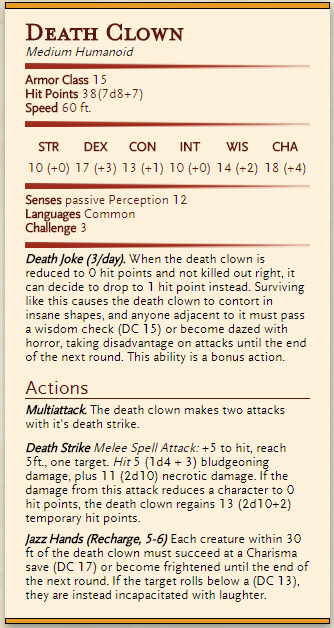
Confused Monsters: The Death Clown

The Death Clown, a being of hideous evil, driven mad by the mix of torture and Stockholm Syndrome, part Joker and part Freddy... and they are the secret police in the hopeful town of Vallaki.

You see, in Vallaki, the only thing that keeps Strahd's forces at bay is the happiness in the commoner's hearts. And the Baron has embraced that, magnifying it to degrees which bear little resemblance to a form of sane leadership. There are festivals every week, people are required to smile in public at all times, fighting in the streets is prohibited. Those that do not - or cannot - keep to these laws are branded Subversive Depressents, and executed during festivals.

On almost every corner in Vallaki, a mime performs all day and all night. The mimes act as spies and informers. Their eyes see everything, and common people slip them notes when the suspect friends, families, or enemies might be Depressents. But the mimes are mostly harmless, at least in a physical confrontation. They aren't trained in the martial arts, they aren't going to stand against a team of adventurers set on overthrowing the twisted government.

No, that honor goes to the Death Clowns. They are only seen just before an arrest. They suddenly appear out of thick crowds as their iconic music plays in the background - summoned with a snap of the finger. Commoners flee at the sound of the song, and tales of Death Clown sightings are spoken in hushed whispers, but only in the safety of home and hearth.

And although the Death Clowns do have some powerful martial abilities, their true power comes from the ability to force status conditions on their enemies, paralyzing them with spasms of panicked laughter that cannot be contained.

Tuesday, May 1, 2018

The Advantage of Friends

I do a lot of game preparation. It's not usually about finding maps, and coming up with monster statistics. It's not usually about trying to predict my player's every move and plan carefully detailed plots. Most of the time I'm thinking about character motivations and interactions, feeling out how my players interactions have changed the web formed by conflicting NPCs that want different things.

Most of the time it's preparing to improv.

However, every once in awhile I come to a place that I know needs a specific scene. The Trials of Mind, Might, and Heart was a scene like that. Preparing a dungeon when you know your players are about to come across it is like that. And my next session is like that too. A lot of things have been building in the background, and tonight it's all coming to a head.

I wanted to be ready, to have a set of iconic scenes prepared and ready to go.

But I was struggling. Like, really struggling. I had a vague idea of how the scenes might play out, but every time I tried to grab hold of one, the idea floated out of reach.

So I called a friend. And she helped me prepare, and now I am feeling super prepared.

Which is the advantage of having a friend that isn't in your game to talk to. Sometimes you find yourself in a situation that just isn't clicking in your head for some reason. You know that there's something good beneath the surface, but when you try to dig it out of the sand, all you find is more sand.

Having a friend to bounce ideas off of can help you find the sweet pearl of player despair under all the dirt.

Your friend doesn't even have to be a dungeon master, although I do find that other DMs can have some very clever insights about things going on in a game. But all you really need is someone that is willing to listen to your ideas, someone to help you brainstorm, and someone who will help shape the urge you feel as a dungeon master to complicate character's lives.

So find a friend and try it some time. I highly recommend it.

Friday, April 20, 2018

Name That Spell: Necromancer Edition!

Here is a cool thing I made! I suggest rolling one or two attributes. Sometimes one fits better than two. Good luck, and have fun!


Tuesday, April 17, 2018

DM Tool: 101 Traps, Puzzles, and Challenges

Sometimes I really like lists and random generators. I rarely roll on them, but they can be great inspiration for encounters. While brainstorming the Trials of Heart, Mind, and Might yesterday, I did some googling, and found a great list of suggestions that really inspired me.

In the end my encounters looked nothing like the suggestions, but the list gave me the jumping off place I needed to create some trials that I think are fairly unique, and will be lots of fun (or terrifying when my players fail).

I will put in a reminder though. Whenever you are dealing with traps, puzzles, and challenges, reward your players for their creativity and ingenuity. Even if you have a solution written down in front of you, don't get into the mind set that the solution is the only way to deal with the situation. Be open to player ideas... often what they come up with is better than anything you did. And if you play it off right, they'll think you made that the solution all along.

Monday, April 16, 2018

The Trials of Heart, Mind, and Might

My players in Curse of Strahd have been a chaotic mess. It's been an excellent game, but their ability to protect Ireena is in major question. For awhile, The Order of the Black Doves (a replacement for the Order of the Feather, that is exactly the same except were-doves instead of were-ravens) decided that the party couldn't protect her, and decided they would do it on their own.

So while the entire party had left Ireena behind at a tavern, the Order of the Black Doves kidnapped her, whisking her across the city to their hidden hideout.

Now the players have tracked them down, and they want Ireena back. And either they will have to kill all the lycanthropic birds, or pass The Trials of Heart, Mind, and Might.

The trials are designed to be tricky and difficult. Failure is a real consideration. And although failure might not result in death, it does mean that the order will not return Ireena without a fight (that isn't likely to go the character's way). 

The Trials

"If you want Ireena back, you must prove your ability to protect her. We will not give her back unless you pass the trials of Heart, Mind, and Might. They are dangerous, and they may destroy you if you do not pass them. Do you truly wish to risk your lives and souls?"

"You do? Very well, we go then."

The characters are led to a platform that descends into an underground chamber. The central chamber is small, just large enough for the platform to descend. But there are three rooms that you can clearly see.

On the left there is a long room. About twenty feet wide, the room starts flat, but then has an ascending slope that goes up in a sharp, sixty degree angle. The ramp leads upwards for fifty feet before flattening out again. At the bottom, where the room is still flat, there is an eight food wide circular crack in the floor.

On the right side, there is another were-dove. But this one is clad in a long black robe, with a cowl so long, that the only thing you can see of it's face is a sharp beak. In his left hand is a corked vial with completely clear liquid. In his right hand is a book, with the phrase Toralia deas Loridal, written on the cover. 

Finally, the room straight ahead of you is a huge circle. It's sixty feet wide in diameter, with crystalline walls that shoot straight up at least fifty feet. The reflection of room's contents shift endlessly around the walls, creating a dizzying rainbow like mirage.

Inside the room are six massive golems:

The first is a golem surrounded with glowing yellow energy, it has a cross shaped hole in it's chest where the energy Cascades out to surround it's fists and torso. The second is a golem of red crystals. It holds a gigantic sword in one hand, and a massive shield in the other, and it's eyes glow with crimson power. The third is a golem carved of ocean blue ice. It's surrounded by a cloud of mist as the warm air clashes with the Arctic chill the golem is formed of. It's tall and slender, and holds a bow formed of the same Arctic blue ice. Next is a golem formed of burning orange flames. It's taller than all the rest, and surrounded by an acrid cloud of sulfur smelling smoke. In it's hands is a massive great axe bigger than even a Goliath could wield. Then there's a floating golem that hovers on waves of sickly green energy. It's fists are surrounded with the energy as well, and although tall, it's slender and sleek. And finally there's a purple golem formed of crystalline spines sharp enough to draw blood with even the lightest prick. The tips seem to glow with arcane energy, and it's face is fixed into a grimace of pure rage.

So... tell me in the comments which room you think belongs to which quest. Because before even starting the trials, that's the first puzzle to solve.

Wednesday, March 7, 2018

Introduction: Improvised Hopes

A blog. About Dungeon Mastering. I feel like I've gone back in time about ten years. It seems like content in the present is all about Tumblr, Twitter, Facebook, and (let's not forget) Google Plus. But although I have a Tumblr that I love, it isn't a great place for conversations. It isn't a great place to post the ramblings of a dungeon master that feels like she has something to say after running games for over two decades. It turns out that saying something longer than 120 characters is better off in an old fashioned blog.

I don't know. Maybe that's just two decades of bias showing itself.

But this is a blog. And as the subtitle makes clear, its about running table top rps. I want to stress the plural in that. 5th Edition Dungeons and Dragons is a wonderful system that will get plenty of time and space. But I love other systems too. I love simple, one page games like Lasers and Feelings. I love games like FATE and PBtA that focus on story and create mechanics to manipulate stories in ways that are completely foreign to a standard D&D game. Those systems will get plenty of space as well.

Then there is the homebrew stuff that I am constantly throwing together. Often times my creations are half hazard monstrosities forced to fit a very specific situation for a single game or session. But sometimes I spend more time designing new things, and I am sure that I'll talk about my design process here as well.

But most of all I created this blog because I want to share my experience as an improvisational Dungeon Master. I learned early (and hard) that careful plans and plots get destroyed well before the first roll of the game is tossed. I've learned to deal with the ridiculous, and how to embrace it and make it good (sometimes even amazing). I've learned that saying yes is more important than saying no. And I've learned that players will always, always surprise you.

Then again, any Dungeon Master with more than a few games beneath their belt has learned most of that. What I hope to bring to the table are tips and strategies that let you roll with moment, and suggestions people can use when they are suddenly slack jawed in horror.

We've all been in that moment. The precise instant that a game you think you have a handle on is suddenly thrown off the hook with a single statement. In Lord of the Rings that moment is when Frodo decides to put on the ring. One of my first moments was when my players used durian fruits to banish a hoard of demons. These are the moments that hit you out of nowhere, that you never saw coming, and that leave you in a panicked mess.

But that moment passes, and what a Dungeon Master does in the seconds that follow can distinguish between the good and the great. And that's what I hope to bring here - advice for turning those moments from disaster into memories that players will talk about for months and years to come.

Cozy Dark

 Cozy Dark is a game I am working on for solo roleplaying. It steals a lot from Ironsworn, a bit from Chaosium's generic roleplaying, an...