Wednesday, April 11, 2018

Diablo TTRPG: Character Sheet

I don't sit down to make a new game system often; but when I do, I always start with a character sheet.

Starting with a character sheet really helps me visualize the things that I need to work on. Beyond that, it makes the project seem more... real, like it has a place in reality, and not just in the twilight moments before I fall asleep. So here it is, the first draft of my character sheet, along with some basic descriptions for each field to fill out.

Before I get to far into it, let's talk about the font first. Almost all the font is in "Diablo Heavy" and "Diablo," fonts that you can easily find for download with a quick google search. I really do love how it calls back to the games.

Let's start off with Attributes. Right now there are four, although I'm thinking about adding a charisma statistic in as well. The TTRPG can't be just about combat, especially not with some of the more creative aspects of the mechanics. There really needs to be a decent social stat. I could combine it with Intelligence, but that doesn't feel right to me.

Anyways, at first level you get 7 attribute points to assign however you want. But you must place at least one in each.


  • Strength increases your melee attack and damage.
  • Dexterity increases your ranged attack and damage. It also increases your Armor Class. Although in the next character sheet, armor class will be changed to defense bonus. 
  • Intelligence increases your magic attack and damage. It might grant you some resistances, but I might just make resistances gear dependent like in Diablo 2. 
  • Vitality increases your hit points. 
Hit Points: Determined by taking 10 and adding your Vitality attribute.

AC Bonus: Equal to your dex attribute.

Armor: You have six armor slots on your character: Head, shoulder, torso, wrist, legs, and feet. To get your total armor bonus, add all slots together and take the total. When you take physical damage, subtract your armor total from the damage.

Resistances: Your resistances are determined by your armor. If a piece of armor gives you a type of resistance, record it in the appropriate box. Resistance stack, so if both you have a Ashen Helm (Head) that grants 2 fire resistance, and Boots of the Sleeping Salamander (Feet) that grants 1 fire resistance, your total fire resistance is 3.

Actions are the abilities that should be recognizable from the game. Things like the Paladin's Thorns aura, or the Witch Doctor's Summon Gargantuan. Actions come in three types:

  • Utility Actions are actions that are either part of a move action, or are used in place of a move action.
  • Standard Actions are actions that can be used if you have moved or used a utility action this round.
  • Full Actions take an entire round to complete.
Each round the player decides between a movement (or utility) + standard action, or a Full Action.

You can only have a few actions equipped at a time. One utility action, one standard action, and one full action (although I may end up making that two). You will know more actions than you have equipped, and can spend an action to swap actions out. So if a Necromancer has the Blood Rush Utility action equipped, but wants to equip the Bone Armor utility action, they must spend a utility action to swap.

Utility actions swap for utility. Standard actions for standard actions. Full actions for full actions.

Tuesday, April 10, 2018

Diablo TTRPG: Base Mechanic

So, I love the idea of playing a fast paced Diablo table top game. I imagine combat being fast and explosive, and instead of being super crunchy, the game would be rather simple. I've wanted to do this for a long time.

And then last night while I was going to sleep, I remembered a system that me and my friend Jim were trying to come up with ages ago. The idea was to create a system based around d12s, because at the time we felt like they were somewhat ignored. And why not take the least common die and make a system out of them?

I'll probably switch to d10s, but I'm really excited about the base mechanic of the game.

Roll 3d12.

If you're making an attack roll:

  • Pick one die for your attack
  • Pick one die for your damage
  • Pick one die for your defense
  • If triplets, apply Explosive Attack
If you're rolling for a skill:

  • Pick one die for success/fail
  • Pick one die for Entanglement
  • Pick one die for Action Die


Now I'll define some of the terms:

Explosive Attack: Is an attack specific effect that makes the attack much better. If your firebolt usually targets one creature, now it explodes and does damage in a radius. Or it sets the creature on fire. Something like that. The effect is defined in each attack description.

Entanglement: This is a die that determines if something interesting happens. If it lows between 1-4, the GM introduces something that makes the situation more complicated. If it rolls between 5-8 there nothing happens. If it rolls 9-12 the GM (or player maybe? That might slow the game down though... still working stuff out) introduces something that makes the situation easier.

  • I like making Entanglement die separate from success and failure. By separating it out, it lets someone succeed in a skill check, while still making things more complicated. The Demon Hunter does get the door unlocked, but because they picked a high number for Entanglement, something else happens which also makes the situation easier. (Maybe the lock didn't break, so you can use it to slow down demons on the chase, things like that).
Action Die: Action Die are class specific moves that drive the action forward while making skill checks. An example might be a Necromancer balancing on a narrow rock ledge above the fire's of hell. But the Action Die allows one of his minions to continue attacking.

There is still a ton of work to do on this. I would really like to incorporate all the classes from both Diablo 1 and 2. I'm still not exactly sure how I want to go with attributes and skills, which skills I want to include, and stuff like that. But I'm really excited about the base mechanic here, I think it has potential to be lots of fun. I especially like letting people pick where to assign dice they rolled, I think it might push some very interesting story decisions. Ie: The Barbarian is almost dead, but the corrupted angel is on it's last legs. He rolled a 6, 2, and 12. He can pick the 12 for attack, and the 2 for damage. But if that doesn't kill the angel, a defense of 6 isn't great, and he risks getting obliterated on the angel's turn.

Monday, April 9, 2018

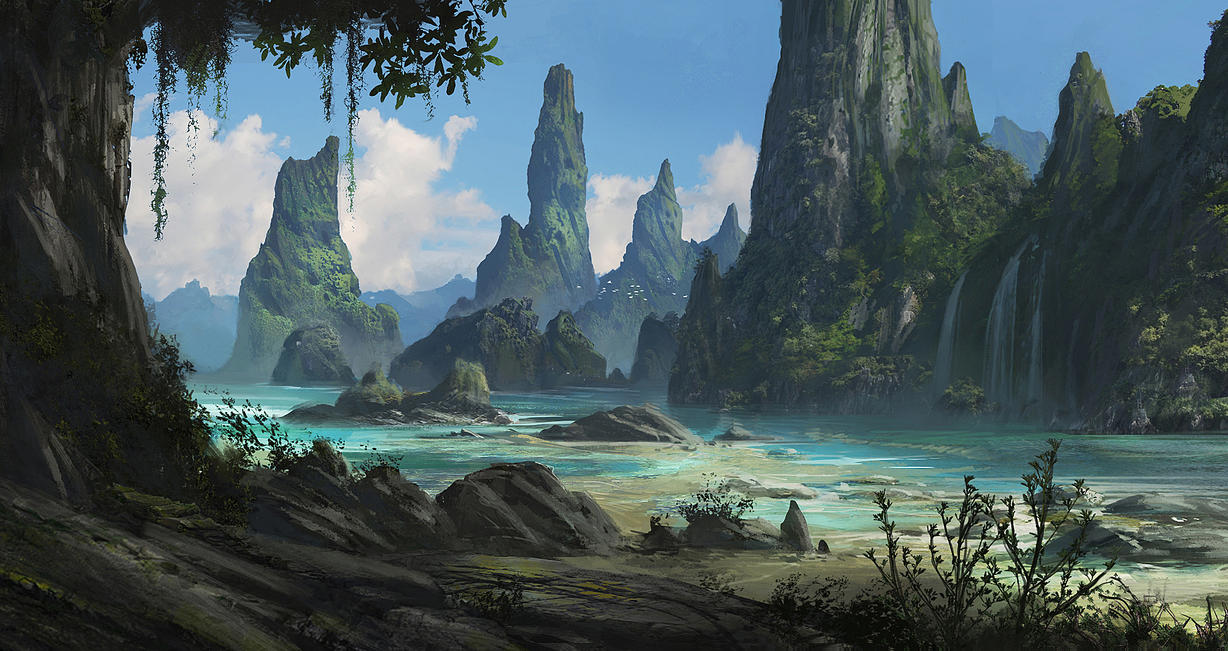
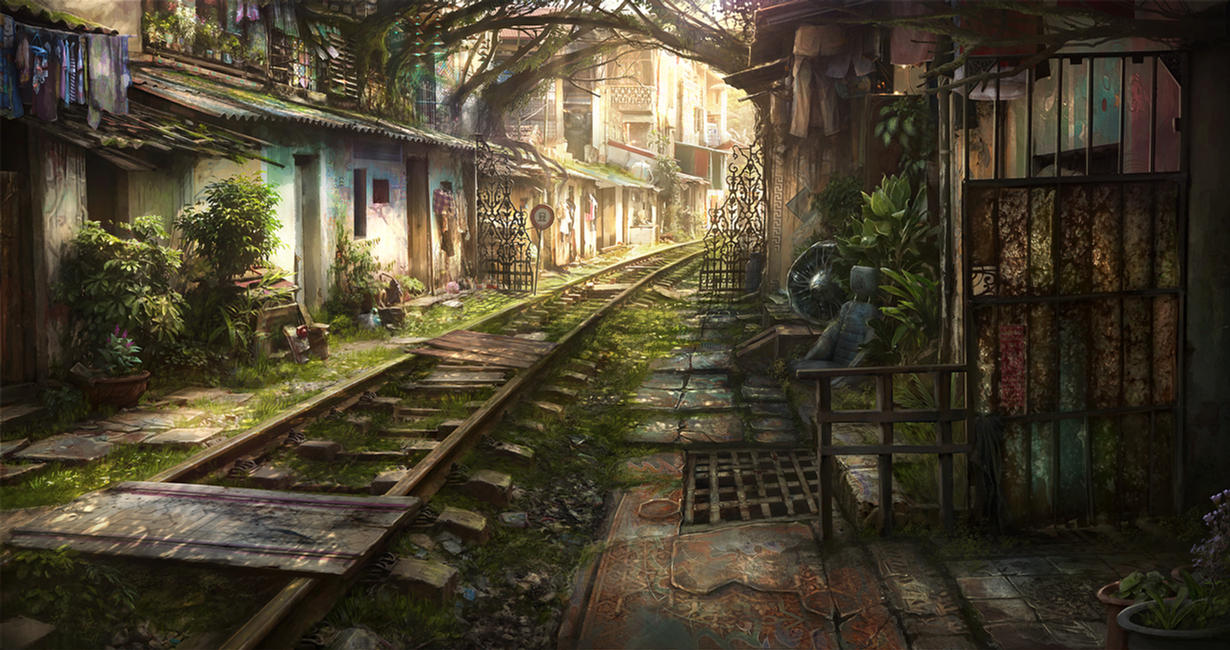
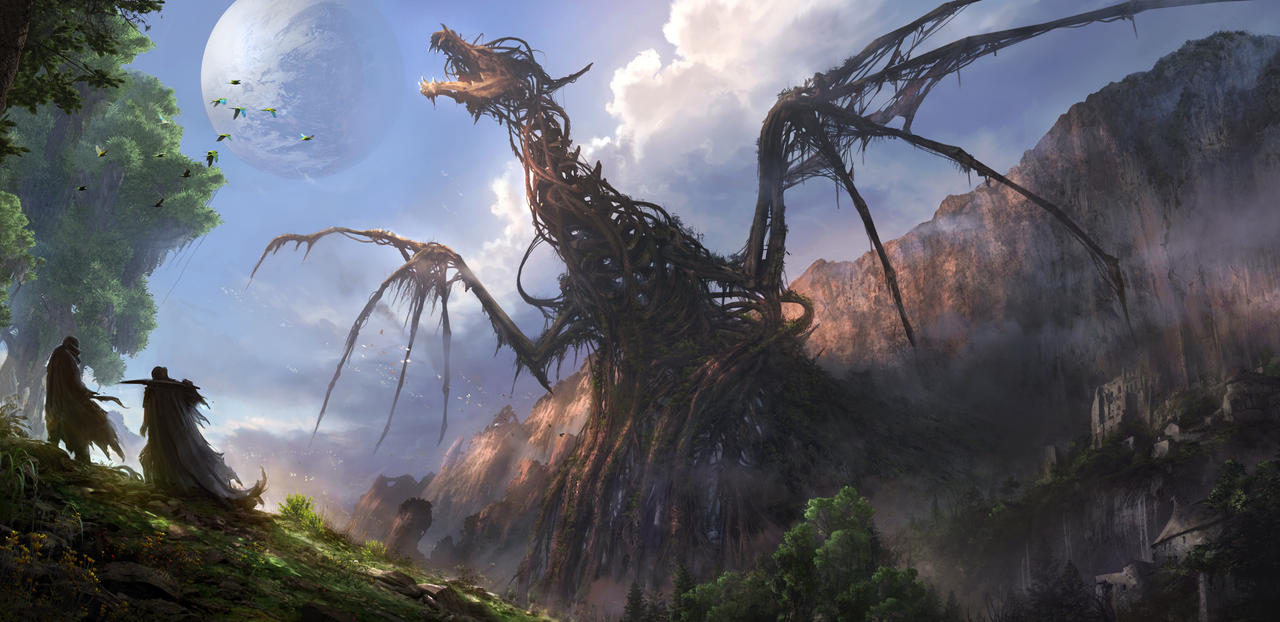
Artist Spotlight: JonasDeRo

Deviant Art can be an amazing place to find inspiration for you games. I love browsing through the art work of amazing authors. Their ability to create mood and feelings sculpted from lightwaves of varying lengths amazes me. In the past when I did an Art Spotlight, I featured a bunch of different artists. But today I've decided to show off one of my favorites, an artist by the handle JonasDeRo.

Sit back, and enjoy these phenomenal works of art.

Cerulia

Gods of Sound

Railroad
Dystopia
Entombed

Saturday, April 7, 2018

Bonus Content: Fanburst and the Podcast

I spent most of the afternoon looking for a hosting platform for the podcast that I'm happy with. So far I haven't really found anything I'm interested. I was excited by the idea of using Amazon Web Services, and Google Drive to host content, but either I'm not techy enough or both services have stopped allowing people to stream from them that way.

So the options right now are to stay on Fanburst, which has unlimited storage space, but not a way to export out to itunes, stitcher, and google play like we probably should do; or throw money at libsyn, which is probably the best way to go, but also a bit more than I wanted to spend.

I'm still looking, but it's very likely we will stay on Fanburst for now. But I'm looking at libsyn, and my guess is we'll eventually end up there.

Friday, April 6, 2018

Banshee and Skullboy: The Podcast

So, I've decided to start a podcast with my friend Skullboy! It's going to be focused on our thoughts and experiences in the dungeon master world, and will likely cover many systems... although the majority of conversation will likely be about different editions of Dungeons and Dragons.

On the first episode we introduce ourselves, and then talk about how awesome one shots are.

It isn't on itunes yet (we are still exploring some hosting options), but if you want to listen to it now you can find the podcast here!

Hero Forge Character Art

As someone who runs most of their games online, mostly using roll-20, I'm always on the look out for good art assets that will make my game look good. Alas, I'm not really a map person, so my games never have the professional polish of dynamic lighting, but I like to have decent looking tokens, character art, and setting art to show off to the players. It adds atmosphere to a game nearly as much as theme appropriate music playing softly in the background.
Before

Today I found a way to create character art that I fell in love with. It's super simple. First you head over to Hero Forge and use the character designer to make the perfect character. After that I opened the screenshot in Gimp (you could use Photoshop, or any number of other graphic design programs). I made a new layer, set the opacity to 55%, and then just used a brush to color in the miniature. It's like coloring in a color book, and because the opacity is set so low, the shadows are preserved in decent detail.

After
I've used other character creators in the past. The Guild Wars 2 character creator is fantastic at designing characters if you happen to own the game. And the creator in Elder Scrolls games are usually pretty good as well, although a bit more grim than I usually like. Elder Scrolls Online is free to download if you want to give that a look too.

Quick post today, but wanted to share something I just discovered that I'm likely to get a lot of use out of.

Thursday, April 5, 2018

Homebrew Lore of Strahd: Death Rituals

I talk about my Curse of Strahd game a lot on this blog, and I hint at a lot of the changes and additions that I've made to the lore. But I haven't had a place to really delve into those changes. Until now. Welcome to the official Homebrew Lore of Strahd column, where I dive into the personal tweaks I've added to the game. Today we are starting off with death rituals in Ravenloft.


Death in Ravenloft is the only escape from Strahd's realm. But even then, escape is not easy. Through the Crucible of Souls, Strahd has the ability to trap any soul leaving Ravenloft, condemning it to an eternity of torture.

He has made the eternity of torture public knowledge, although he keeps information about the Crucible to himself. Still, Strahd loves his games, and he has set up a way for souls to escape: when a person dies, they must be buried by an approved priest before the third midnight after their passing. If it is done, he allows the soul to travel on to the afterlife. But if not, the soul is his to do with as he will.

The priests approved by Strahd must complete the entire ritual of death by themselves. They are responsible for preparing the bodies, digging the graves, administering the last prayer. They are allowed no help, and if aid is given Strahd's contract is null and void.

In a land where almost no divine magic persists, Strahd has still created a place for the priesthood. And although he makes sure that the priests are almost always behind in their work, the priests are given great honor and respect. For it is only through them that escape from the horrors of Ravenloft is possible.

Wednesday, April 4, 2018

Homebrew Lore of Strahd: Divine Magic

I talk about my Curse of Strahd game a lot on this blog, and I hint at a lot of the changes and additions that I've made to the lore. But I haven't had a place to really delve into those changes. Until now. Welcome to the official Homebrew Lore of Strahd column, where I dive into the personal tweaks I've added to the game. Today we are starting off with divine magic in Ravenloft.

Divine magic is powerful in the hands of the righteous and the faithful. It thrives on hope, even in the darkest places. After all, without light there can be no darkness. Without hope there can be no despair. Except in Ravenloft. For there are some places dark enough to extinguish even the last ember of hope in a darkened heart.

Besides, darkness is the natural state of the universe. Those who say that without light there can be no darkness have it backwards. Without darkness there can be no light.

The Crucible of Souls

Deep in the bowels of Castle Ravenloft there is a room containing the Crucible of Souls. The Crucible is a power artifact. Powered by the agony of a thousand souls, maintained by a cult of thirty two dark cultists, the Crucible form a block between Ravenloft and the divine. No god has been able to overcome it's power, and the only divine magic in Ravenloft is that which Strahd allows.

When Strahd wants to let a god have power in his land, he can place a divine symbol of that god into the crucible. Until he takes it out again, divine power from that deity can flow into his realm. But cutting it off is as easy as removing the symbol.

Strahd often places the symbols of the deities that his toys play with. After all, it wouldn't do to allow new divine casters in Ravenloft to believe that he could cut off their magic in an instant. He often lets them keep their power until the final confrontation, and then leaves the clerics and paladins helpless before him.

Tuesday, April 3, 2018

Taco Tuesday: Lamentations of the Flame Princess

Welcome to Taco Tuesdays, where I add more meat to your gaming tortilla by featuring cool, new systems! This week I asked my friend +Sam Mameli to make a post. He runs a blog over at Skullboy Rolls the Dice, and when I told him to pick a fun system to feature he told me he was going to write about "Everything is Dolphins." Then he wrote about this instead... maybe it's a dolphin too? I don't quite get it...

Okay so Mute asked me to do a guest post for her blog and I was like "that's a good idea I'll do that" then I sat around like a bum for a while because I'm terrible at doing things. BUT WHAT HO!? Is this a blog post I see? Something meaty or full of salsa or something because this is a day sometimes related to the humble taco???

Okay that was exhausting, I can't capture Mute's energy but I can write about a game that I like in what sure will be a much drier tone than you're used to. I'm gonna break this up into a couple of different categories to make it easier to digest.


Lamentations of the Flame Princess

System

LotFP is at it's heart a clone of the Moldvay Basic D&D ruleset. If you don't have any idea of what that means from a rules perspective let me break it down-


Race as class - You can play as a Fighter, Specialist, Magic User, Cleric, Dwarf, Elf or Halfling. Each of these classes functions differently and the classes that are non-human function sort of like hybrids of the human classes.

High Mortality - Death is a very real possibility. Old school play is meant to be dangerous and thrilling, your character dances on the edge of a knife and has like 2 hit points maybe so it forces you to be clever to survive.

Rules Light- Another trademark of old school play is "rulings not rules" which lends itself to systems that don't spend a lot of time with fiddly rules. I personally love this, because half the time a player asks to do something wild it's not covered in whatever crunchy ruleset I'm playing in and I end up just coming up with something on the fly anyways.


Vancian Spellcasting- The term "Vancian" references Jack Vance, writer of "The Dying Earth" "The Eyes of the Overworld" and numerous other pulp fantasy tomes. He wrote magic to be weird and fleeting and extremely dangerous, and his characters would spend hours memorizing their spells only to have them flee from their minds after casting them. I like this system for magic because its fast and easy. You can memorize so many spells per day and after that, they're gone until you can rest and re-learn them. This can make magic users feel pressure to save their spells for important moments, and creates a decent amount of tension.

Treasure = XP- You gain experience by delving into dungeons and getting treasure, which I personally prefer to getting xp from killing things, it encourages players to think outside the box and resort to all sorts of capers to retrieve their treasure and get their levels.

Setting & Tone


The default setting of the game is 17th century earth, with some extra weirdness like monsters and elves thrown on top of it. I absolutely love this because it gives players an automatic foothold in the world, which if you've spent any time learning about, is just about twice as weird as most fantasy worlds, and 100% easier to explain. I've found it actually gives me a reason to read up on things like "what was Prague like in the 17th Century". This of course is totally optional and the setting is by no means married to the system, hack it as you please without much trouble at all.

As far as tone goes, LotFP is solidly in the fantasy/horror camp. If you dig the overly gruesome and grotesque, blood spewing horror flicks and body horror, this is the game for you. If you don't dig that, maybe this isn't the game for you, use your noggin, you're an adult.

Art

Lamentations art is rad as all get out. On top of that it tends to feature powerful female characters, which is also awesome. I know for a fact that these artists are well paid, which is something you should care about if you have a heart in your chest.


Cynthia Sheppard


Jason Rainville


Zak Smith


Design


Above all things, Lamentations design sensibility is what stands out to me. As a graphic designer I often find myself in physical pain attempting to use a WOTC or other large publishers game book simply because they aren't designed right. I think it was Zak Smith who said that RPG books are more like cook books than anything and it's completely true. A book should be useful at the table and I've found more often than not that Lamentations books are easy to read and digest without much prep. The most shining example of this I can provide is how LotFP utilizes the inside front and back covers of their books.


LotFP Player Core Book - Rules & Magic


Blood In The Chocolate - Kiel Chenier


A Red & Pleasant Land - Zak Smith


Broodmother Skyfortress - Jeff Rients


If you have every run even 10 minutes of any RPG you know how valuable quickly accessible and easy to parse information is. Which is why most RPG design is such a slap in the face. LotFP design is more like a nice kiss on the cheek.

Monday, April 2, 2018

Inspiration: Endurance, A Year in Space, A Lifetime of Discovery

I read a lot of books. Like, a lot. Last year I hit over one hundred and twenty before losing count half way through November. And one of the great things about reading is that it can be amazing inspiration for a game.

So I've decided that when I read a book that I like, and that gives me good ideas for a game, I'll drop in and express my inspiration. Today I'm going to start with a book called Endurance: A Year in Space, A Lifetime of Discovery.

I know, it's a long title. But the book itself isn't that long, and the story of a man that goes into space just to find out what the long term health ramifications are is amazing. Scott Kelly is a man devoted to space travel, to science, to family and friends.

The book itself is told in a sort of frame, switching between Scott's current time on the International Space Station, and his time growing up down on Earth.

And as I was out on a walk catching Pokemon today, I had a thought. His story would make an interesting setting for a game if it gets switched around a bit.

Picture a world where magic was a literal sea of arcane and divine energy. Land masses exist on the surface, floating islands of self contained civilizations. But there is little travel between the islands, because the Seas of Magic destroy anything it touches.

But then one of the islands comes up with a shield of sorts that protects a ship (or a special metal alloy, something along those lines). Suddenly travel between the islands is possible, but journeys can often take months at a time. And traveling on the Seas of Magic isn't like traveling on an ocean. The traveling crafts sink beneath the surface, gravity is a thing of the distant past, and traveling through the Magic has... consequences. Maybe it seeps into a person's spirit, forming one into a sorcerer. Or maybe the magic slowly eats away at your sanity, driving you to the brink of madness.

Little is understood, and there is a need to know more. So a small team of people is put together, not to travel in the sea, but rather to exist in it on an immobile station. The goal? Spend a full year in the magic to discover how it affects mortals over a long period of time.

The game itself switches between the quiet sessions on the craft (except for the rare emergency), and flash back scenes that delve into each character's story. I kind of like the idea that each character's story has the players running different characters, switching as the stories shift from person to person. The campaign becomes a string of linked together one shots, but with the back drop of the station always in the background.

I'm pretty full up on games I'm running right now, so this will likely sit on the back burner and never get used... but I really like the idea, and wish I had the time to run every idea that came into my mind.

Friday, March 30, 2018

Curse of Strahd as a Sandbox

So, if you've been following me for any decent amount of time, you will have scene by several rants about the Curse of Strahd book. I've complained that Death House as a dungeon didn't have encounters that reinforced the theme of the adventure. I've complained that the Village of Barovia is portrayed as a boring place with nothing interesting going on. But then I had a conversation with someone (I don't remember who, my friend Julia maybe?) about my frustrations, and she was all, "it's a sandbox, Lexi."

That made me take a step back. I've been treating the adventure path like a sandbox. I added a really fun story arc in the Village of Barovia with Ireena. Since she refused to leave before her father was buried, I added in this scene at the church. It was being assaulted by dire wolves as the father worked to dig a grave for Ireena's father. But the deadline for her father's soul to escape Ravenloft was midnight (I've come up with lore that if you aren't buried within three days after dying, your soul belongs to Strahd).

The priest was burying Ireena's father... only, Strahd had made a deal with him. Make sure that soul gets to me, and I will fix your son. So Father Danovich was digging the grave slowly, buying as much time as he had.

Eventually the characters realized what was going on, and has thousands of ravens swarmed in the skies above (raven swarms), they forced him to complete the burial ritual. Then the characters escaped the church and fled from the town as the ravens bit and scratched them to bloody pieces.

But finally they escaped into the fog. Only to come face to face with Strahd himself, and through the vampire lord experience just how horrific Ravenloft is.

It was a super fun adventure, full of tension, intrigue, and suspense. And at the end of it, I was angry that the book hadn't provided something interesting for the players to do like that.

Only, if Curse of Strahd is a sandbox, it sort of did. I didn't make up Ireena, or Father Danovich, or even Danovich's son locked in the basement slowly turning into a vampire. I did add the Direwolves in, but in other chapters of the book it's mentioned that Strahd uses them. The only thing I really added to the setting was some lore about the importance of burial rituals, and that they can only be performed by priests that Strahd has given the duty to. Everything else was there.

I just played with it, twisted it to my own ends, and came out with a really fun couple of sessions.

When the characters escaped Strahd, they badly wanted a town to rest in that wasn't the Village of Barovia. In my mind I thought that Vallaki was much closer to the town than it is on the map, so I introduced it as a place of refuge. And it's themes are perfect. Barovia is a hopeless place of the downtrodden, but on the surface Vallaki is a place of happiness and freedom! I'm so glad that I introduced this town early, because the juxtaposition between the two towns is amazing.

But when I started preparing for Vallaki, I approached it differently. Instead of expecting to find an adventure to run, I just noted down major NPCs. I noted what their motivations were, how much power they had on a scale from 1-3, and what their reputation was with the players. I came up with this:

The list below is a list of factions, a summary of power (rated 1-5), and it's reputation with the players (starting at 0 and progressing from -3 to +3).

Urwin. Innkeeper of the Blue Water Inn. Holding Tomb of Strahd. Quest: Retrieve the wine (award: treasure chest. 140 gp, 70 pp. 2 elixers of health, 3 potions of healing, and 1 grey bag of tricks). Power: 2. Reputation: -1.

Wolf Hunters: Szoldar Szoldarovich and Yevgeni Krushkin. Hunt dire wolves and sell meat and skins for a living. Will work for money. Excellent guides, some information. Know that people are shipped off to Castle Ravenloft, only tell if they are paid 100 gold. Power: 1. Reputation: 0

Rictavio: A half-Avariel bard. Aerie's son, and worshiper of the Gnome God Wildwanderer. His real name is Elaroth, but he has adopted Rictavio after the legendary vampire hunter "Rudolph van Richten." He has heard of the Keepers of the Feather and is trying to get in contact with them. He is also gathering information on the Vistani camped to the north west. They are working for Strahd (taking villagers from the Burgomeister and taking them to Castle Ravenloft). Once he finds out, he plans on attacking them with his saber-toothed tiger. Power: 1. Reputation: 2 (because of Ariane).
Rictavio's Journal: In his room, open on his desk, is a journal Rictavio writes to keep up the illusion that he is an entertainer in search of new acts for his traveling carnival. He makes frequent mention of conversations with Drusilla (his horse, although the journal fails to mention that). He also writes about various oddities he has seen in his travels, including:
  • A "werehare" child (a boy who transforms into a rabbit on the full moon)
  • A half-orc woman named Gorabacha who could chew through iron chains
  • A giant, man-eating plant that has the most beautiful singing voice he's ever heard
  • A pair of conjoined goblins
  • A small man with no legs named Filmore Stunk who could drink whole casks of wine without getting drunk.

The Valakovich Family: Power 3, Reputation 0
  • Baron Vargas Vallakovich: Ruthless. Unhappy. Bent on keeping the city free of Strahd. Festivals to provide hope. Publically the hope "Keeps Strahd at bay," but in reality, when people die of hope, he has their bodies shipped to Castle Ravenloft. Catchphrase: "All will be well" Secrets: Bodies, Almost 200 years old by virtue of Strahd's blood. Always accompanied by two huge mastiffs.
  • Izek Strazni: The Baron's servant, and "Hand of the Baron." He is supposed to be in charge of the government's economic well being, but in reality he is the person that the Baron uses to disappear people. All the mimes on the street corners report to Strazni, and are willing to take out whoever he orders.
  • Baroness Lydia Petrovna: Vargas' wife. She has desperately picked up her husband's insistence that "all will be well" but at the cost of her sanity, for she does not believe it. She hosts daily high tea ceremonies at the mansion, which is mostly attended by the poor because all the nobles have been put off by her strangeness caused by her desperation. She is the younger sister of Father Lucian Petrovich, who is the leader of the Church of Pelor.
  • Baronet Victor Vallakovich: Miserable and depressed, wants nothing but to get away from the city. He is adamantly opposed to the "Tyranny of Happiness" that his father governs with. He found a spell book in the attic, and is trying to build a teleportation circle to escape (give players hope of escaping Ravenloft?)
Watcher Family: Power 2, Reputation 0
  • Lady Fiona Watcher: Leader of the Watcher House. She craves to rule the city, and makes no secret of her loyalty to Lord von Zarovich (Strahd's official title). She is the High Priestess at the Temple of Shar, and is allowed some actual divine power by Strahd for her loyalty. However, at most she can cast 2nd level spells, and then only clumsily (all concentration checks made at a disadvantage). However, more than Shar, she is a member of the Cult of Awakening, who believe that the Eternal Sleeper will awaken from his slumber, and the world that is his dream will be destroyed. She has a book of summoning rituals in her private chambers, with the same snake symbol as that at the Death House.
  • Nikolai and Karl: Brash Drunkards, always looking for trouble. They don't like talking about their mother, but they would be overjoyed to join a revolution.They love listening to character's tales of adventure, the more harrowing the better. Power: 0. Reputation: 0.
  • Ernst Larnak: Fiona's spy. He is a super greedy person who would love to get job with the Baron, however Fiona has seen to it that he would never be welcome there. He knows Fiona's secrets, and would love to sell them to someone who would free him from her power.

Gadolf Blinsky: The toymaker of Vallaki, "Is no fun, without Blinsky!" Used to be a mime in the employee of the Baron's spy. He still feels a great debt to Izek for getting him the store, and makes free dolls for the man every month. The dolls are supposed to represent Ireena, and they are shipped to Strahd along with the shipment of bodies. He adamantly believes in the Baron's "all will be well" slogan, and he has a collection of super weird and creepy toys. Power: 0, Reputation 0, Contacts 2. 

Ivankov Valerianovich - Baker in town. No one leave Ivankov place sad! Power: 0, Reputation 1, Contacts 0

Manqoba's Fashion: Manqoba is a Shadar' Kai fashion maker who was banished from the tribe after trying to challenge for the throne. He somehow maintained his life, but he ran from the city, and the leader would love to have him killed. Luckily it is incredibly rare for Shadar' Kai to leave their village. His status as a tailor for the well to do gives him tons of information, and he is incredibly good at playing the game of intrigue. Power: 1, Reputation: 0, Contacts 4
I love this! If I was publishing it, I'd clean it up some. But it's just a list of NPCs that I can look at in the moment and decide what's going on. For example, the Baron is already pretty upset with two of my players for being unhappy on the streets. He has invited them to dinner at his mansion where he plans on doing away with them.

However, my players don't know that, and are just excited to go to the Baron's. They wanted to shop for proper outfits, and so I introduced Manqoba's Fashions. When Manqoba heard about the invitation he knew what was up, but he knows the game of intrigue. And so just as the players are about to leave, he says, "Oh, wait, I just thought of a perfect thing to go with that dress," and he pulls out an elegant silver Ouroboros (snake eating it's own tail) on a thin chain. It goes great with the dress, but the players have no idea it's the symbol for Lady Marks, and that by wearing it they are showing that they have her backing.

All of this to protect the players, and they don't even know it's happening yet. And although I've added in Manqoba, all the other players in this little intrigue are in the book. I'm just using them.

So, to sum up, I still have some problems with the actual book. But I also think I owe an apology to the book as well. It has some really fantastic situations, NPCs, and events. It's just up to the DM to pull that together. And in the end, as a fan of improvisational Dungeon Mastering, that's all I really want to do anyway.

Cozy Dark

 Cozy Dark is a game I am working on for solo roleplaying. It steals a lot from Ironsworn, a bit from Chaosium's generic roleplaying, an...